Custom Search

Friday, November 13, 2009

NISSAN SCHOOL OF FISH-INSPIRED ROBOTIC CARS MAY REDUCE ACCIDENTS


If it promises to bring down altercations brought about by road rage too, I'm all for it.


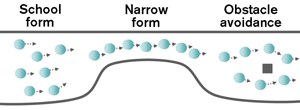
Nissan's robotic concept is designed for groups of cars. The basic idea is patterned after the behavior of fishes when moving in a school. See image below.


EPORO Robot Cars, as these robotic cars are called, are going to be equipped with lateral line sense and sense of sight capabilities. The cars' movements are supposed to be governed by three fish-based behavioral rules: collision avoidance, traveling side-by-side, and approaching.


'Collision avoidance' will allow them to avoid collisions with other cars even while change directions. 'Traveling side-by-side' will enable them to move at the same speed as the other cars near and around them. Finally, 'approaching' will allow the cars to move as close to each other as possible.


If all these will be achieved, open spaces between cars can be reduced thereby maximizing road sizes; each vehicle in a group can move as fast as the fastest car; and most of all, collisions can be avoided.


At first glance, this idea may seem feasible especially for vehicles traveling in practically the same direction, e.g. in the same lane. Fishes in a school move at blazing fast speeds, weaving through corals, going to one direction then another in a blink of an eye. And they seem very peaceful going about their business. Not that I know what's going on in their minds.


I'm just curious how Nissan's engineers are going to tackle problems like, who goes first? I mean, sure we haven't seen fishes going through an altercation. =) But maybe that's because their brains are too unsophisticated that they don't mind if one fish goes ahead of them. Many people usually fume mad when somebody cuts them off or overtakes them.


Anyway, this new technology will be demonstrated by Nissan using six EPOROs during the CEATEC Japan 2009 on October 6-10 at the Makuhari Messe. Maybe then, the folks at Nissan will be able to enlighten us some more.

IROBOT PACKBOTS SOON TO ACQUIRE SENSE OF TOUCH


The Remote Touch Kit will be co-developed by makers of a video game controller known as the Novint Falcon. Soon, the top battlefield robot will be a product of two companies that have been highly successful with household devices.


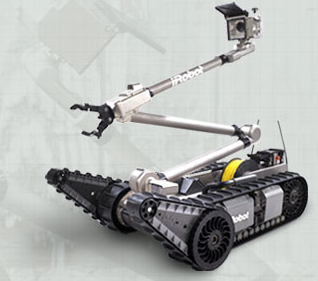
The Packbot is a creation of and currently being developed by iRobot, makers of the disk-shaped intelligent vacuum cleaner known as the Roomba. Novint Technologies, the company that has brought the Novint Falcon haptic game controller to numerous homes, has recently been awarded a subcontract with iRobot to co-develop the PackBot's sense of touch.


Funding for the project will be provided by the Secretary of Defense Joint Ground Robotics Enterprise through the Robotics Technology Consortium (RTC).


Their objective is to come up with what will be known as the iRobot PackBot's Remote Touch Kit (RTK). Through the RTK, soldiers controlling the robot from a distance will be able to "feel" whatever it is the robot is holding with its manipulator (robotic arm).


This will enable the robot to better handle fragile objects and to provide the right feedback representative of the weight of the object it is carrying. This feature is particularly important in bomb disposal operations. Ground troops and their robot companions frequently encounter improvised explosive devices or IEDs.


Aside from that, the controlling soldier will also receive force feedbacks whenever the robot encounters bumps as it navigates to its destination. This will give the soldier a better idea as with regards to the actual terrain the robot is navigating on. Right now, with the absence of such enhancements, PackBots usually just plough through even the roughest terrains.


Such disregard for the ground topography will not only increase the robot's wear and tear, it is also very inefficient since the robot has to exert more effort while pressing on.